

Fascinating Flower Facts
Scroll down to see all the fun flower facts!
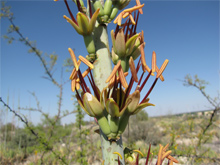
Agave lechuguilla,
Lechuguilla, Shindagger
The leaves of lechuguilla contain hard fibers, called istle or ixtle, that Indians used to make baskets, rope, sandals, brushes, and clothing. Today istle is known commercially as Tampico fiber. Extracted by small operators in Mexico, it is used for making rope, brushes, mats, and carpets.
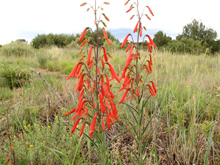
Penstemon barbatus,
Scarlet Penstemon, Scarlet Bugler, Hummingbird Flower
The flowers of scarlet penstemon appear from June through October, when its hummingbird pollinators are migrating through the Rocky Mountains to Central America for the winter. The association of hummingbirds with this plant is so strong that the Navajo name means "hummingbird food."
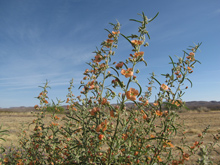
Sphaeralcea angustifolia,
Copper Globemallow, Narrow-leaf Globemallow
Pueblo people made a paste from the pulverized roots of globemallow to harden adobe floors in their houses. Today the Santo Domingo still add boiled globemallow to house paint to improve its quality.
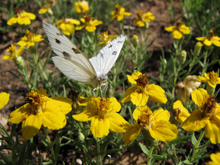
Zinnia grandiflora,
Rocky Mountain Zinnia, Plains Zinnia
Zinnia was named by Linnaeus to honor Johann Zinn, an energetic German who, in his short thirty-two years of life in the mid-1700s, was an ophthalmology professor and director of the botanical gardens in Göttingen. Not only did he provide an accurate description of the eyeball's nerves and blood vessels, but he also traveled to Mexico, where he collected seeds of what is now the garden plant Zinnia.
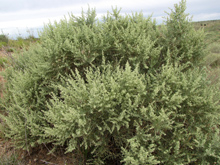
Atriplex canescens,
Four-wing Saltbush, Chamiso
The alkaline ashes from four-wing saltbush were important in the nixtamalization of corn. The Navajo and other corn-producing Indians in North America processed corn with the ashes to soften the hull of the corn to make it easy to remove. The process also makes the various seed components more nutritionally accessible. Increased availability of the amino acids lysine and tryptophan, along with niacin (vitamin B3), is among the more notable benefits of nixtamalization. Both protein deficiency and pellagra became common when corn was introduced around the world following the voyages of Old World explorers to America because knowledge of the nixtamalization process did not accompany its spread.
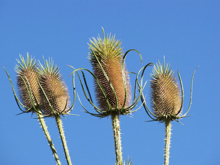
Dipsacus fullonum,
Fuller's Teasel
Fuller's teasel was important for the woolen textile industry until the industrial revolution in the 1700s began to reduce the demand for its services. The flower head's stiff bristles are strong enough to raise the nap on woolen cloth and to straighten it. Fullonum, the species name, refers to fullers, people who fulled cloth, which is the laborious process of thickening the fabric with moisture, heat, and pressure. This species was introduced from Europe and was cultivated from about 1840 in New York, subsequently spreading across the United States via the extensive road network.
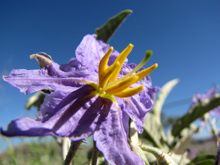
Solanum elaeagnifolium,
Silverleaf Nightshade, Horsenettle
Although the berries contain the poisonous glycoalkaloid narcotic solanine, they are also rich in enzymes, which the Navajo, Zuñi, Cochiti, and Pima add to boiling milk as a rennet to separate it into solid curds for cheese and liquid whey for a drink. Hispanics use the berries in a similar process to make asadero, a delicious white cheese made for home use as well as commercial sale.
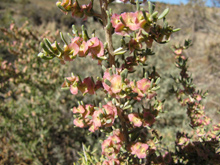
Sarcobatus vermiculatus,
Greasewood, Black Greasewood
When a Navajo girl has her coming-of-age ceremony, one of her treasured gifts is a bundle of greasewood stirring sticks which she will use for cooking throughout her life, even bequeathing them to her descendants.
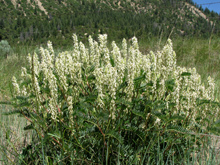
Astragalus bisulcatus,
Two-Grooved Milkvetch
Two-grooved milkvetch is toxic due to its hyperaccumulation of selenium, which causes poisoning related to selenium's structural similarity to sulfur. It is used as an indicator plant for selenium to help identify soils rich in this mineral.
